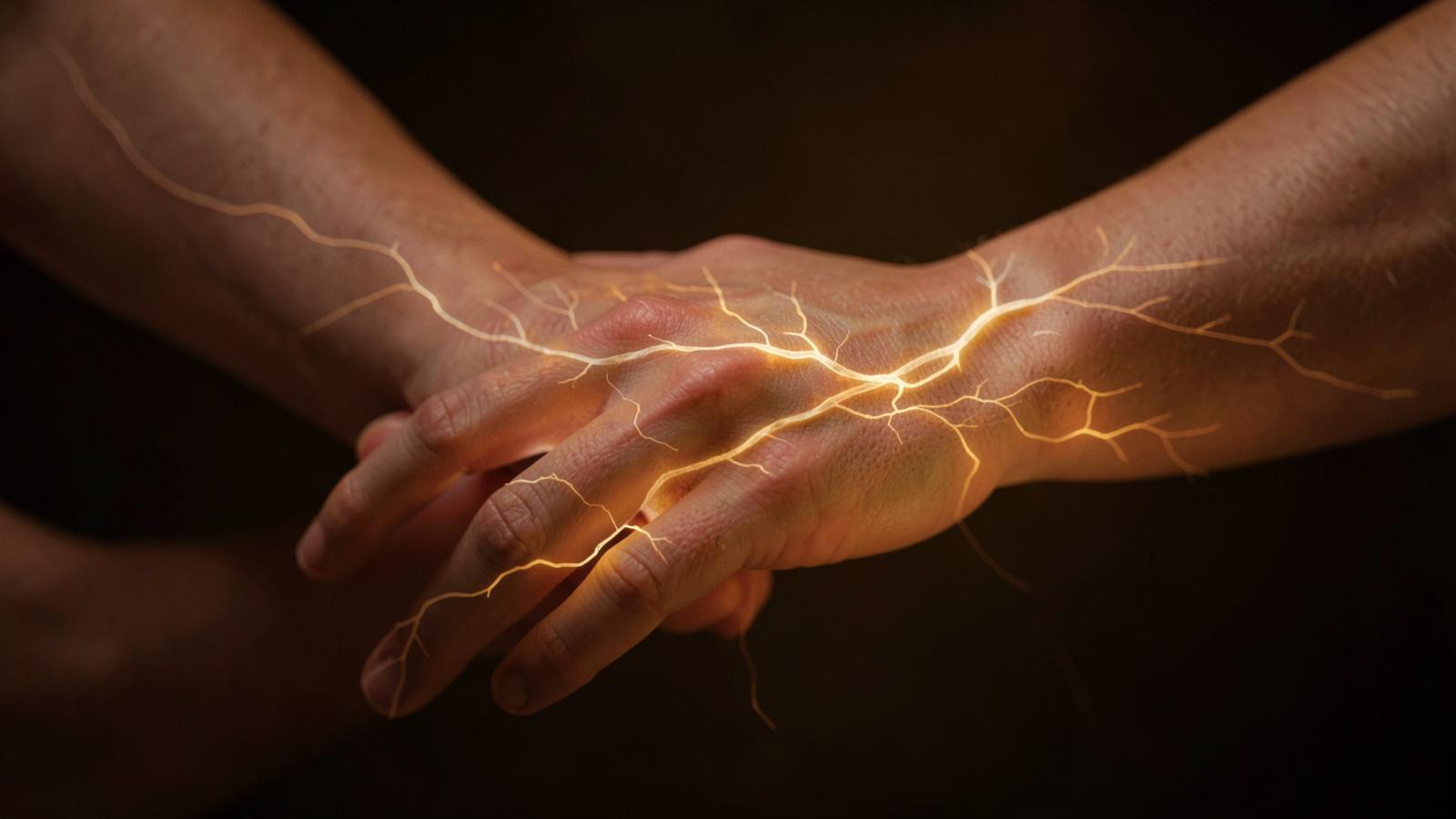
Every nerve impulse, heartbeat and muscle contraction depends on controlled movement of charged particles. Bioelectricity is not metaphorical; it is one of the basic languages of living tissue.
When we hear "electricity," we imagine copper wires, sockets and batteries. Biology uses different materials, but many of the underlying ideas are familiar. Cells separate charged particles across membranes. That separation creates voltage. Channels open and close. Ions move. Electrical differences change. Information travels.
The voltage across a cell membrane is tiny, usually measured in millivolts, yet it is essential. Neurons use rapid changes in membrane voltage to send action potentials. Muscle cells use electrical signals to trigger contraction. Pacemaker cells and cardiac muscle coordinate the rhythm of the heart. Even cells that do not fire classical action potentials use membrane voltage and ion movement to regulate transport, signalling and internal chemistry.
The cell membrane behaves like a controlled barrier
A cell membrane is a thin lipid barrier that separates the inside of the cell from the outside. Ions such as sodium, potassium, calcium and chloride cannot simply move through the lipid portion at will. They depend on channels, transporters and pumps. This controlled permeability makes electrical separation possible.
The sodium-potassium pump is one important example. Using ATP, it moves sodium out of the cell and potassium in. Other channels allow selective movement down electrochemical gradients. Together, these processes contribute to the resting membrane potential. In neurons, opening voltage-gated channels can rapidly alter that potential and generate a travelling electrical signal.
Voltage and chemistry are inseparable in biology
In a metal wire, we usually focus on electron flow. In the body, much electrical behaviour comes from ions dissolved in water. That means "electrical" and "chemical" are tightly linked. An ion may be pulled by an electrical field while also moving because its concentration is higher on one side of a membrane than the other. The combined force is called an electrochemical gradient.
This is why simple comparisons between the body and a household circuit can only go so far. Biology is wet, selective, adaptive and self-repairing. The "wires" are membranes and tissues; the charge carriers are mostly ions; and the system changes its own channels and transporters in response to activity.
Nerves: information as changing voltage
Neurons maintain a resting membrane potential and, when stimulated strongly enough, can generate an action potential. Sodium channels open, the membrane depolarizes, potassium channels contribute to repolarization, and the electrical event propagates along the axon. Myelin can speed conduction by allowing the signal to effectively jump between specialized regions called nodes of Ranvier.
At the end of many neurons, electricity becomes chemistry again. The arriving action potential triggers calcium entry, neurotransmitters are released, and the next cell receives the message through receptors. The nervous system is therefore neither purely electrical nor purely chemical. It is an electrochemical conversation.
The heart is an electrical organ too
Every heartbeat is coordinated by electrical activity. Specialized pacemaker cells in the sinoatrial node spontaneously change their membrane potential and initiate impulses that spread through the atria, pause through the atrioventricular node and then travel through the ventricular conduction system.
An electrocardiogram does not directly photograph the heart's electricity inside individual cells. It records voltage differences detectable at the body surface that arise from coordinated electrical activity across large regions of cardiac tissue. The familiar ECG trace is a macroscopic signature of countless ion channels opening and closing in a highly organized sequence.
Muscle: electricity becomes force
In skeletal muscle, a nerve impulse reaches the neuromuscular junction, stimulates an electrical response in the muscle membrane and leads to calcium release inside the muscle fibre. Calcium then permits the molecular interaction between actin and myosin that generates contraction.
This sequence is a beautiful example of biological energy conversion: chemical energy maintains ion gradients; an electrical signal propagates; calcium acts as a messenger; ATP powers molecular motors; and a visible movement results. A raised arm begins with events too small to see.
Bioelectricity beyond nerves and muscles
Researchers also study slower electrical patterns in development, regeneration and wound repair. Cells in epithelia can create transepithelial voltage differences, and injuries disturb local ionic currents. Laboratory research suggests that bioelectric cues can influence cell migration and tissue patterning, although translating these findings into therapies is a developing field.
This is an important place to separate science from exaggeration. The existence of bioelectricity does not validate every device or wellness claim that uses words such as "frequency," "voltage" or "energy." A product can borrow scientific vocabulary without demonstrating a clinically meaningful effect.
What supports healthy electrical function?
Normal electrical physiology depends on intact cell membranes, adequate energy production, functioning ion channels and appropriate concentrations of electrolytes. Sodium, potassium, calcium and magnesium all matter, but the body regulates them within narrow ranges. More is not automatically better, and self-treating suspected electrolyte problems with large doses can be dangerous.
Physical activity, cardiovascular fitness, sleep and adequate nutrition support the systems that maintain cellular energy and membrane function, but there is no single "bioelectric hack." The body's electrical behaviour emerges from coordinated physiology.
The Ika's Realm takeaway
The most interesting part of calling the body electric is that it connects biology with engineering without reducing one to the other. Cells create voltages. Organs coordinate currents. Signals move through networks. Yet the system is alive: it repairs, adapts and changes its own components.
Key takeaways
- Cells maintain a voltage across their membranes using ion gradients.
- Nerve, muscle and heart function depend on controlled ion movement.
- Electrolytes matter because they carry the charge.
- “The body is electric” is literal physiology, not metaphor or mysticism.
Enjoyed this?
Get the next one straight to your inbox.
Keep reading
Related articles
Explore more natural food, fermentation and wellness ideas from Ika’s Realm.
Mitochondria — The Tiny Energy Systems We Still Don't Fully Understand
They are often called the "powerhouses of the cell," but mitochondria are far more than miniature batteries. They sense, signal, divide, fuse, recycle and help decide how a cell responds to stress.

Touch Is Information — Skin, Pressure and the Nervous System
A hand on the shoulder, the pressure of the floor under your feet, warmth on the skin — touch is not merely sensation. It is continuous information the nervous system uses to map the body and the world.
Home Electricity for Beginners — AC, DC, Volts, Amps, Watts and kWh Without the Headache
You do not need to become an electrician to understand your energy bill, a battery or a power station. Five ideas — voltage, current, power, energy and AC/DC — explain most of what beginners need.