Pistachio & Cashew Nut Tofu — The Next Generation of Plant-Based Foods
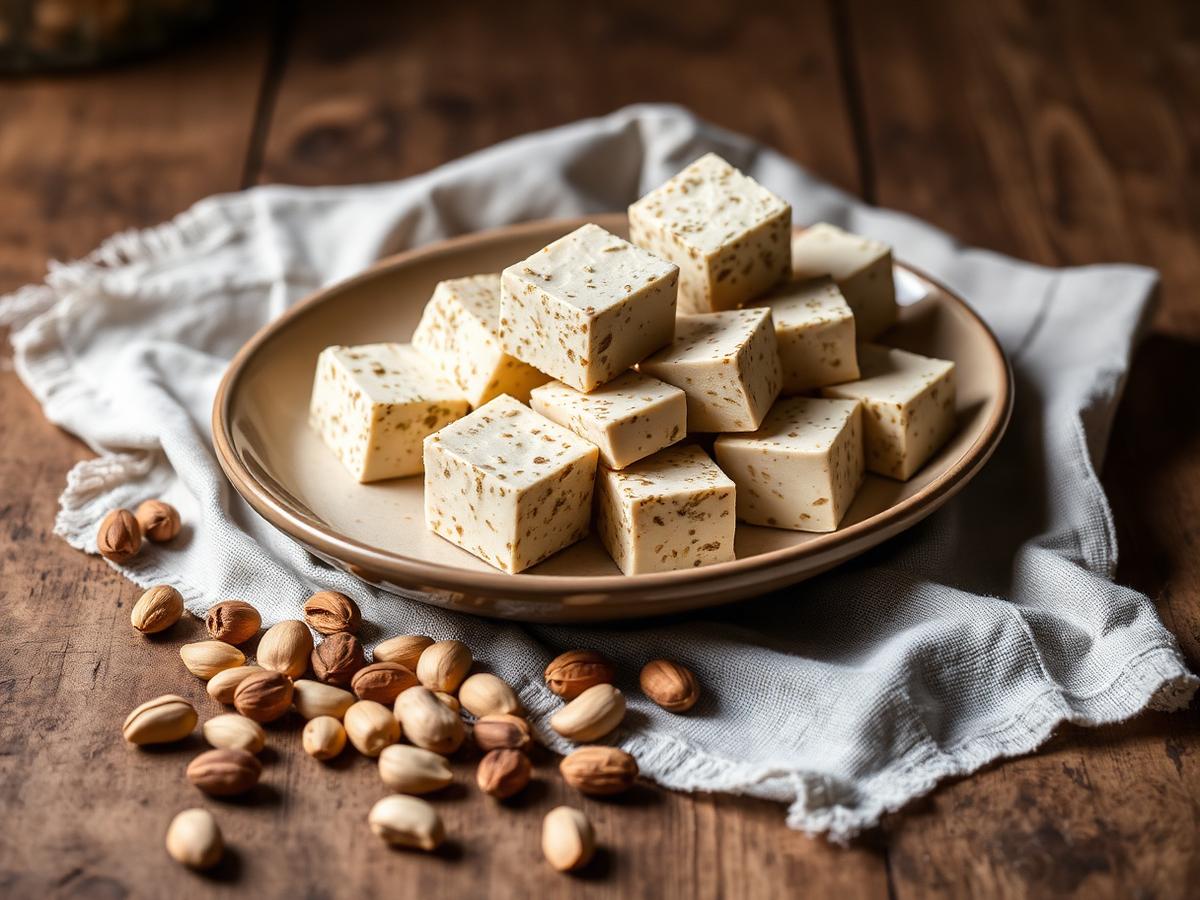
An experimental, soya-free block inspired by tofu-making: pistachios and cashews soaked, blended and set into something entirely its own. Contains nuts.
Tofu is a technique before it is an ingredient: extract a plant milk, heat it, coagulate it, press it. Once you separate the method from the soybean, a whole family of possibilities opens up — and nuts are one of the most interesting places to start. What follows is our attempt at that, along with an honest account of where the technique transfers and where it simply does not.
Pistachios and cashews both provide protein, fat, fibre and minerals. Cashews are rich in soft, emulsifying fats that blend to a genuinely creamy purée. Pistachios bring less fat but more colour, aroma and a distinctive sweetness, and are a source of potassium and vitamin B6. Neither contains soya, which makes this an interesting route for people avoiding it — though it swaps one common allergen for another.
Soaking matters more than people expect. Six to eight hours softens the cell walls so the blender can release the fats and proteins rather than shredding dry fragments, which is the difference between a smooth base and a gritty one. Soak in the fridge in warm weather, and always discard the soaking water.
Here is the honest part, and the reason this recipe changed before publication. Our first version followed the tofu method literally: strain a nut milk, heat it, add nigari, press the curds. It does not work. Soy proteins — glycinin and beta-conglycinin in particular — aggregate into curds when destabilised by magnesium or calcium salts. Cashew and pistachio proteins simply do not behave that way, and straining the purée throws away most of the solids in the pulp. What you get is a pan of thickened milk with nothing to press.
So we rebuilt it around a gel instead of a curd. The whole nut purée stays in — that is where the protein, fat and body live — and the structure comes from agar-agar with cornflour alongside it. Agar sets firmly once it has been properly boiled and stays firm at room temperature, which is what makes the block sliceable and sear-friendly. Starch on its own gives something closer to a very thick blancmange: delicious, but it slumps.
Texture develops in three stages: the blend, the cook and the chill. Blending builds the emulsion, boiling hydrates the agar and gelatinises the starch, and cooling is where the block actually firms. Skip the chill and you have a very good sauce.
Lemon juice earns its place for flavour and a little protein tightening, not for coagulation. Call the result what it is: tofu-inspired, not tofu.
For flavour, treat the base as a neutral canvas — white miso for savoury depth, lemon zest and herbs for brightness, black pepper and smoked paprika for a sear-friendly version.
Compared with soybean tofu, this is softer, richer, sweeter and considerably more expensive. It browns faster because of the fat, and it will not survive long braising. Use it where its creaminess is the point.
Recipe card
How to Make It
Ingredients
- 150 g raw cashews, soaked 6-8 hours in cold water (in the fridge if your kitchen is warm)
- 100 g raw shelled pistachios, soaked 6-8 hours
- 500 ml filtered water, for blending
- 1 tsp fine sea salt
- 35 g cornflour or tapioca starch (about 4 tbsp), slaked in 60 ml cold water
- 4 g agar-agar powder (about 1 rounded tsp) — this is what makes the block genuinely sliceable
- 1 tbsp lemon juice, for flavour and a little tightening
- Optional: 1 tsp white miso, 1/2 tsp toasted sesame oil, or lemon zest
Equipment
- High-speed blender
- Coarse sieve (optional — see the notes)
- Heavy-based saucepan and silicone spatula
- Small loaf tin or square mould, about 10 x 12 cm, lightly oiled
- Cling film or baking paper to line the mould
Method
- 1Drain and rinse the soaked nuts well, discarding the soaking water. Blend with the 500 ml filtered water for 90 seconds, until completely smooth and creamy.
- 2For a rustic block, use the purée as it is. For a smoother one, push it through a coarse sieve — but do not strain it through a nut milk bag: the solids you would remove are the protein and fat this block is built from.
- 3Pour the purée into the saucepan, whisk in the agar powder while cold, and bring slowly to a gentle simmer, stirring constantly so it never catches. Simmer for 2-3 minutes — agar only sets once it has properly boiled.
- 4Whisk in the slaked starch and cook another 3-4 minutes, stirring hard, until the mixture is thick, glossy and holds a trail from the spatula.
- 5Take off the heat, stir in the salt, lemon juice and any optional flavourings. It will thicken further as it cools, so work quickly.
- 6Scrape into the lined mould, level the top, press a piece of baking paper to the surface to stop a skin forming, and leave to cool at room temperature for no more than an hour.
- 7Chill for at least 4 hours, ideally overnight. Agar sets firm when cold; the starch keeps it tender rather than brittle.
- 8Turn out and slice with a sharp knife. Keep refrigerated and eat within 3 days.
Allergen information
Contains nuts (cashews, pistachios). Serious allergen — never serve it without telling people what is in it, and keep it well away from food prepared for anyone with a nut allergy. Optional additions bring in soya and gluten (white miso, soy sauce) and sesame (toasted sesame oil); check labels, and choose tamari if you need a gluten-free option.
Storage
Wrap closely or keep in a sealed container in the fridge and eat within 3 days. Do not store it submerged in water like soy tofu — the starch and agar structure softens and the block falls apart. It does not freeze well; the texture turns crumbly and weeping.
Serving ideas
- Cubed into a kombu-shiitake broth just before serving — add it at the end, as it will not survive long simmering.
- Pan-seared in olive oil until the edges are golden, finished with lemon and flaky salt.
- Crumbled over roasted vegetables in place of a soft cheese.
- Marinated briefly in miso, soy and a little maple, then baked at 190°C for 15-20 minutes.
Ika's Realm notes
- Cashews give creaminess and body; pistachios give colour and a sweet, green flavour. A 60:40 ratio is our favourite.
- Be honest about the chemistry: nut proteins do not coagulate into curds the way soy proteins do with nigari or gypsum. The structure here comes from a starch and agar gel carrying a nut emulsion, which is why we tested it as a set rather than a pressed curd.
- We tried the pressed-and-curdled route first — strain a nut milk, heat it, add nigari, press it — and it did not work. Without the curd, there is nothing to press, and you end up with a thick sauce. That version has been retired.
- Agar is the non-negotiable ingredient. Starch alone gives a set that slumps at room temperature and cannot be sliced cleanly.
- If your block is too firm, drop to 3 g agar next time; too soft, go to 5 g.
Key takeaways
- Soak, blend, boil with agar, chill — the tofu technique inspires this block, but the chemistry is different.
- Agar and starch build the structure; nut proteins do not form curds, so there is nothing to press.
- An experimental Ika's Realm concept, not traditional tofu — and a serious nut allergen.
Enjoyed this?
Get the next one straight to your inbox.
Keep reading
Related articles
Explore more natural food, fermentation and wellness ideas from Ika’s Realm.
The Science of Natural Umami — Why Kombu & Shiitake Are So Powerful Together
Glutamate, guanylate and the synergy effect: why two quiet ingredients together taste far more savoury than either one alone.
Kombu: More Than Seaweed — Umami, Minerals & the Art of Japanese Broth
A beginner's guide to the sea kelp behind dashi: what it is, how to use it, how to store it, and why more is not better.
Beginner's Sauerkraut: Two Ingredients, Endless Payoff
Cabbage, salt and patience. Everything you need to make your first successful ferment — and how to know it's going right.