Fire Cider vs Elderberry Syrup: Two Winter Traditions Compared
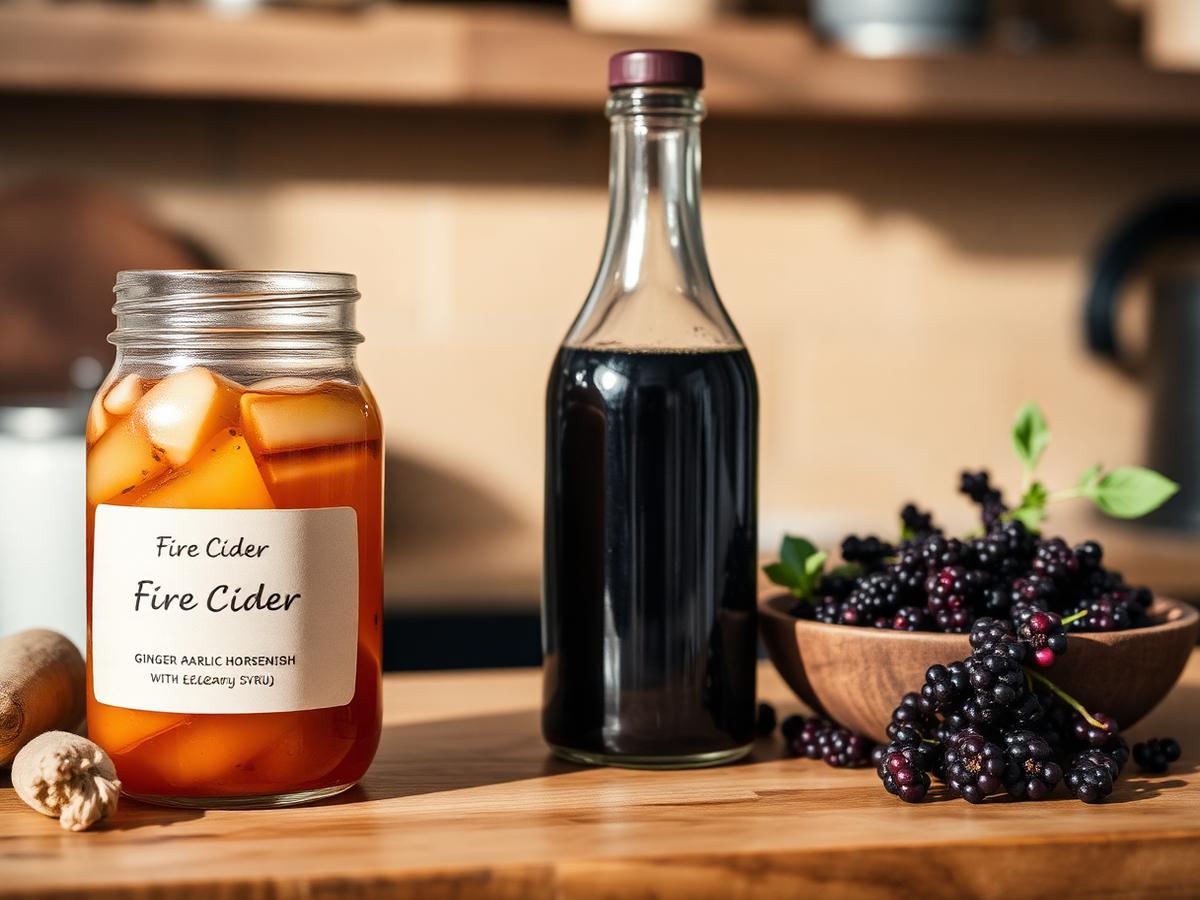
One is a spicy vinegar infusion, the other a cooked fruit syrup. Two very different winter preparations, and why the difference matters.
Every autumn the same two jars appear on kitchen shelves and in the same online conversations, as though they were interchangeable winter remedies.
They are not remotely alike. One is a raw, fiery vinegar infusion; the other is a cooked fruit syrup where cooking is a safety requirement rather than a preference.
What fire cider is
Fire cider is apple cider vinegar infused with pungent aromatics: typically ginger, garlic, horseradish, onion, chilli and turmeric, sometimes with citrus peel, rosemary or thyme.
The ingredients are chopped, packed into a jar, covered with vinegar and left in a cool dark place for two to four weeks, shaken occasionally. The liquid is then strained and often sweetened with honey.
The name comes from the American herbalist Rosemary Gladstar in the 1970s, though vinegar infusions of this kind are far older across many European and Asian kitchens.
Its character is sharp, hot and savoury. It behaves like a condiment and is genuinely excellent in dressings, marinades, bloody marys, braises and broths.
What elderberry syrup is
Elderberry syrup is made by simmering elderberries in water, straining out the solids and combining the liquid with honey or sugar, often with cinnamon, cloves or ginger.
The flavour is dark, sweet and slightly tart, somewhere between blackcurrant and damson. It is used on porridge, yoghurt, pancakes and ice cream, and stirred into sparkling water or hot drinks.
Cooking is not a stylistic choice here. It is the safety step, and it is the single most important thing to understand about the preparation.
Why the difference matters
Fire cider is a raw infusion preserved by acidity. Its vinegar base is what keeps it stable, and its intensity is what limits how much of it anyone consumes at once.
Elderberry syrup is a cooked fruit preparation preserved by sugar and, to a lesser degree, refrigeration. It is mild and sweet enough to eat by the spoonful, which is a very different risk profile.
They are also used differently in the kitchen: one is a seasoning, the other is a sweet topping. Substituting one for the other in a recipe will not work.
Traditional context
Elder has a deep folk history across Britain and Europe, appearing in hedgerow cookery, country wines, cordials and a great deal of folklore about the elder tree itself.
Vinegar infusions have an equally long lineage as a way of preserving aromatics and extracting flavour before refrigeration existed. Fire cider is a modern, American-named descendant of that practice.
Both traditions are worth keeping alive as food. Both are diminished, in our view, when they are sold as medicine.
What research suggests
Elderberry has been studied in small human trials, mostly using standardised commercial extracts, in relation to cold and influenza symptoms. Some results are suggestive; the trials are small and the evidence is not conclusive.
Garlic, ginger and horseradish all contain interesting compounds with laboratory-demonstrated activity, but that does not translate into a demonstrated clinical effect from a spoonful of homemade vinegar.
Neither preparation should be presented as a treatment, a preventive or an alternative to vaccination or medical care for serious infections.
Safety notes
Elderberries must be thoroughly cooked. Raw or inadequately prepared berries, and the leaves, stems, bark, seeds and unripe fruit, contain compounds that can cause nausea, vomiting and gastrointestinal upset.
Use only berries you can identify with complete certainty, strip every stem before cooking, and never forage something you are unsure about. Several look-alike plants are genuinely dangerous.
Honey must not be given to infants under 12 months, which rules out honey-sweetened syrups for babies. Refrigerate syrup after making it and use it within a few weeks, or freeze it in portions.
Fire cider is strongly acidic: dilute it, rinse your mouth with plain water afterwards, and avoid brushing immediately. Garlic, horseradish and chilli can aggravate reflux, and concentrated preparations may interact with anticoagulant or antiplatelet medication — check with your clinician if this applies to you.
Key takeaway
Fire cider is an infused vinegar to season food with; elderberry syrup is a cooked fruit syrup to pour over it. Learn the safety rules for each, enjoy them as winter foods, and let medicine be medicine.
Key takeaways
- Fire cider is an infused vinegar; elderberry syrup is a cooked fruit syrup.
- Elderberries need thorough cooking, and only berries, never stems.
- Honey must not be given to infants under 12 months.
- Neither replaces medical care for serious illness.
Enjoyed this?
Get the next one straight to your inbox.
Keep reading
Related articles
Explore more natural food, fermentation and wellness ideas from Ika’s Realm.
Kombucha vs Apple Cider Vinegar: Two Ferments, Two Very Different Foods
They appear in the same wellness conversations, but kombucha and apple cider vinegar are made differently, taste differently and are not interchangeable.
Honey-Preserved Fruit — Rediscovering an Ancient Kitchen Idea
Fruit macerated in honey is one of the oldest ideas in the kitchen. Here's what honey really does, what it doesn't, and how to do it safely today.
Cured Egg Yolks: The Umami Ingredient That Grates Like Cheese
Salt draws water out of a fresh yolk until it is firm enough to grate. One of the simplest demonstrations of preservation changing texture entirely.