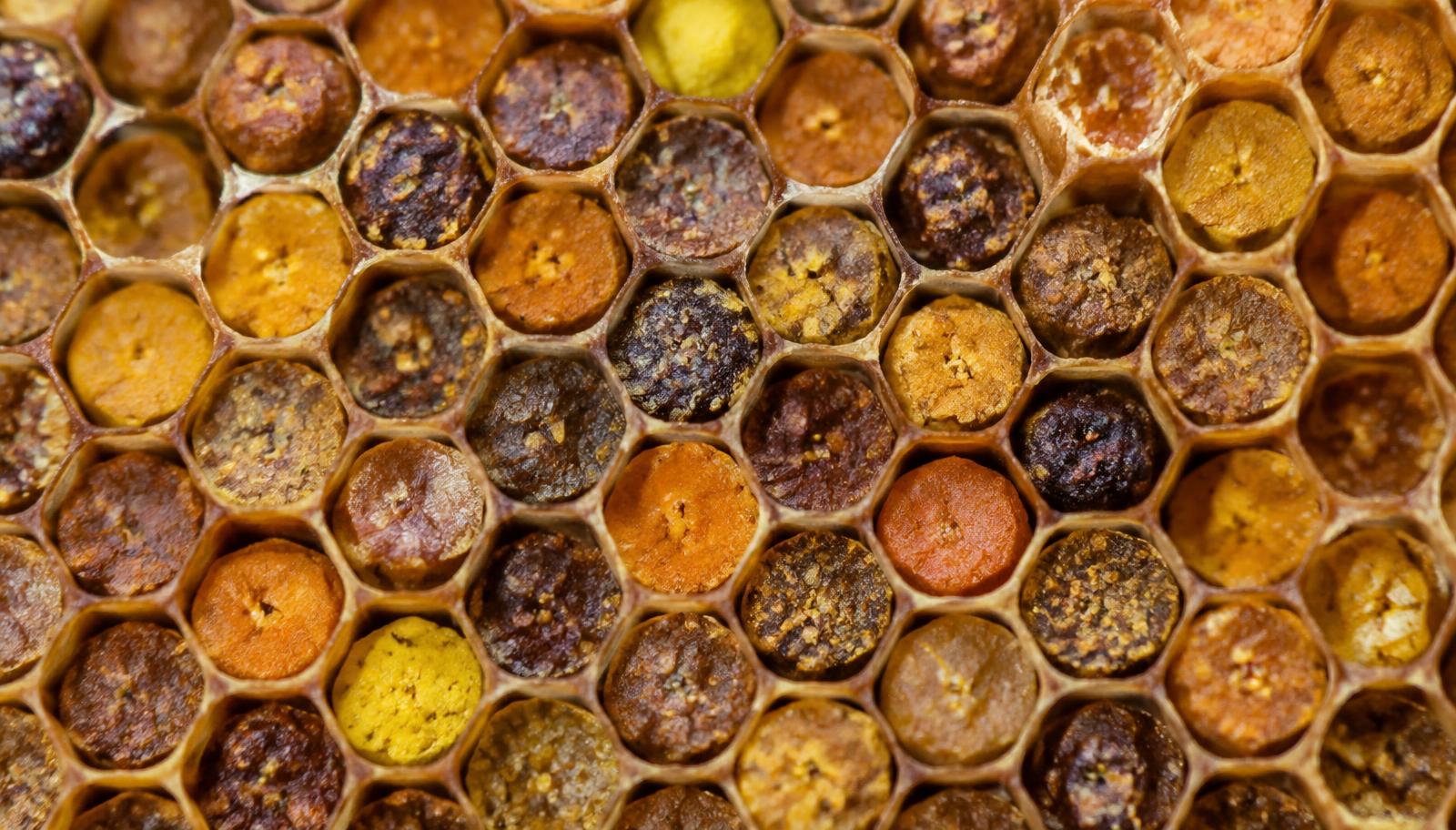
Perga is pollen stored in honeycomb and transformed by microbial and enzymatic activity. Fermentation, it turns out, was never a human invention.
Long before anyone buried cabbage in salt or left dough on a warm shelf, fermentation was already happening inside beehives.
Bee bread, or perga, is the result: pollen packed into honeycomb cells and slowly transformed by microbes and enzymes into something quite unlike the pollen that went in.
How bees make it
Foraging bees collect pollen on their bodies and pack it into baskets on their hind legs, binding it with nectar and glandular secretions as they go.
Back at the hive, the pollen is pressed firmly into comb cells and topped with a layer of honey, which seals it from air. That seal is the crucial step.
Inside the anaerobic, sugar-rich cell, lactic-acid bacteria and yeasts begin to work. The stored pollen acidifies over a matter of weeks, and its structure and composition gradually change.
What fermentation changes
The tough outer wall of a pollen grain is famously resistant. Microbial and enzymatic activity in the cell appears to break some of that structure down, which is thought to make the contents more accessible.
Acidity rises as lactic acid accumulates, and this both preserves the store and inhibits spoilage organisms. In effect, the colony is making a sealed, acidified silage.
The result is darker, softer and more sour than fresh pollen granules, with a flavour somewhere between sourdough, dried fruit and honey.
Why the colony needs it
Honey is the colony's carbohydrate store; bee bread is its protein store. Nurse bees eat it to produce the royal jelly and brood food that developing larvae depend on.
Without an adequate pollen store, brood rearing suffers. This is why beekeepers watch pollen frames as carefully as honey supers.
It is also why harvesting perga requires care and restraint. Taking too much removes the colony's protein reserve, and responsible beekeepers harvest only surplus.
Nutritional context
Analyses of bee bread report protein, amino acids, carbohydrates, fatty acids, vitamins, minerals, lactic acid and polyphenols. It is a genuinely nutrient-dense substance.
The critical caveat is variability. Composition depends entirely on which plants the bees visited, the season, the region and how long the material was stored, so published figures vary enormously between samples.
It is also eaten in tiny quantities — a teaspoon at most. That means its contribution to daily nutrition is small, whatever the concentration figures suggest.
What research suggests
Bee bread has attracted interest from food scientists studying its fermentation, its polyphenol content and its antioxidant activity in laboratory conditions.
Human research is scarce and preliminary. There is no good basis for describing bee bread as a treatment for any condition, and marketing claims in this area frequently outrun the evidence.
Our interest in it is different. It is a naturally occurring lacto-fermentation, complete with acidification and preservation, carried out by insects rather than people.
Allergen and safety notes
Pollen and bee products can trigger allergic reactions. In susceptible people those reactions can be serious, and cases of anaphylaxis have been reported with bee-derived foods.
Anyone with a known pollen or bee-product allergy, or a history of severe allergic reactions, should use appropriate caution and take medical advice before trying it. People with asthma should be particularly careful.
Start with a few granules rather than a spoonful. Stop immediately if you notice itching, tingling lips, swelling, rash or stomach upset, and seek urgent medical help for any breathing difficulty or facial swelling.
Bee bread contains honey and bee-derived material, and honey must not be given to infants under 12 months. Buy from beekeepers who store it properly, since it is a moist product and requires refrigeration or freezing.
Key takeaway
Perga is pollen turned into a sealed, acidified, microbially transformed store — a reminder that fermentation is a natural process humans learned to borrow rather than invent. Approach it as a curiosity, cautiously, and never as a remedy.
Key takeaways
- Perga is pollen transformed in the comb by microbes and enzymes.
- Composition varies with the plants, season and place.
- Allergy risk is the main practical caution, and can be serious.
- Honey must not be given to infants under 12 months.
Enjoyed this?
Get the next one straight to your inbox.
Keep reading
Related articles
Explore more natural food, fermentation and wellness ideas from Ika’s Realm.
Bee Pollen: Nutrient-Rich Food or Nature's Multivitamin?
Bee pollen is genuinely nutrient-dense and genuinely variable. A calm look at what it contains, what it cannot replace, and who should be careful.
Honey-Preserved Fruit — Rediscovering an Ancient Kitchen Idea
Fruit macerated in honey is one of the oldest ideas in the kitchen. Here's what honey really does, what it doesn't, and how to do it safely today.
Oat Kvass — A Forgotten Fermented Drink Worth Rediscovering
Gently sour, faintly sweet and lightly fizzy: how to make a kvass-style oat ferment at home, and how to tell a good one from a bad one.