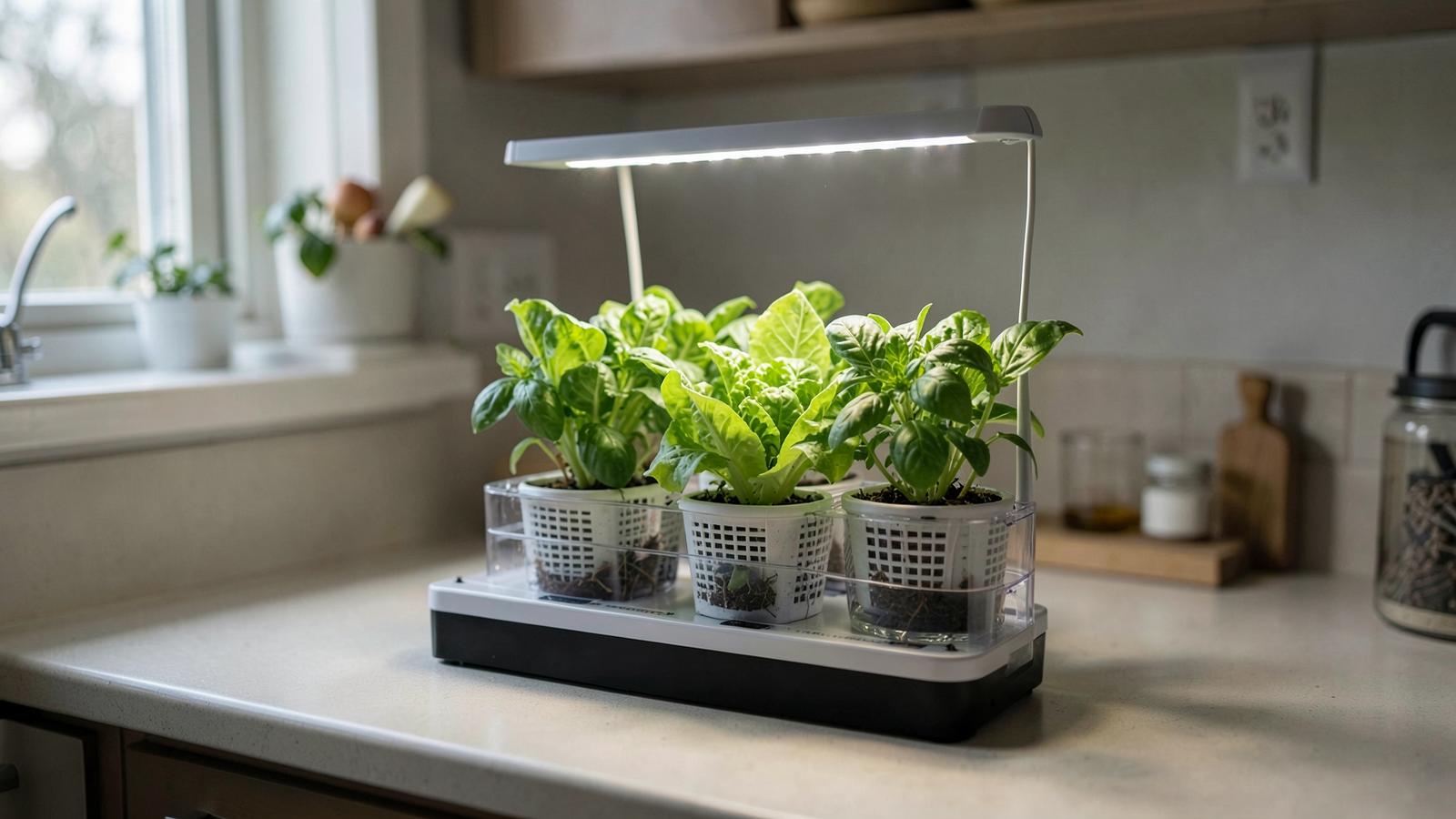
Hydroponics grows plants without soil by delivering water, oxygen and mineral nutrients directly to roots. Here is a practical beginner route from herbs to leafy greens.
A basil plant does not need soil because it loves dirt. It needs water, oxygen, light, carbon dioxide and mineral nutrients in forms its roots can absorb. Soil is one way to deliver those things. Hydroponics is another. By removing soil and managing the root environment directly, a small indoor system can grow herbs and leafy greens in surprisingly little space. The trade-off is that the grower becomes responsible for conditions that soil normally buffers.
The simplest definition
Hydroponics means growing plants without soil, usually with roots exposed to a nutrient solution or supported in an inert medium such as clay pebbles, perlite or coconut coir. Systems range from a jar holding one herb to pumps, reservoirs and nutrient-film channels. Beginners do not need commercial complexity. A small passive system can teach the core principles before pumps and automation are added.
Start with forgiving crops
Leaf lettuce, basil, mint, pak choi and other leafy greens are easier first projects than fruiting tomatoes or cucumbers. They grow quickly, have relatively modest structural demands and let you see nutrient or light problems before months of work are invested. Start with one or two crop types so that the nutrient solution and light schedule do not become a compromise between plants with very different needs.
Light is usually the limiting factor indoors
A sunny window may support herbs in some seasons, but winter light in northern climates is often insufficient for strong growth. A purpose-designed grow light gives more control. The goal is not simply brightness to human eyes; plants respond to light intensity, spectrum and duration. Keep lights at the manufacturer’s recommended distance and provide a daily dark period rather than leaving them on continuously.
Nutrients, pH and water
Hydroponic fertilisers supply nitrogen, phosphorus, potassium, calcium, magnesium and trace elements in soluble form. University extension guidance often expresses nutrient targets in parts per million. Beginners are usually better served by a complete commercial nutrient formulated for hydroponics than by mixing raw salts from scratch. pH affects nutrient availability, so a basic meter or test kit is useful. Clean water and clean equipment also matter.
Choose one beginner system
A Kratky-style passive container is one of the simplest systems: roots grow partly into nutrient solution while an air space develops above the falling water level. Deep-water culture adds aeration with an air stone. Wick systems are simple but less suitable for thirsty plants. Nutrient film technique is elegant but more dependent on pumps and flow. The best first system is the one you can understand completely and clean easily.
Hygiene and reset routines
Indoor growing is not automatically sterile. Algae grows when light reaches nutrient solution, roots can rot when oxygen is poor and contaminated hands or tools can spread microbes. Use opaque reservoirs, wash hands before harvesting, remove dead plant material, clean equipment between crops and keep pets away from open systems. Fresh produce should still be washed before eating.
Why hydroponics belongs in HOME
Hydroponics turns a windowsill, shelf or spare corner into a small food system. It teaches feedback: leaves tell you about light and nutrients, roots tell you about oxygen and water, and the reservoir records what the plant has used. That is very much the Ika’s Realm idea — a home that behaves more like a living system, where resources are observed, adjusted and cycled rather than simply consumed.
Key takeaways
- Hydroponics is simply delivering nutrients in water instead of soil.
- Light is usually the limiting factor indoors, not nutrients.
- Start with lettuce and herbs in one simple system, and keep a cleaning routine.
Further reading
Enjoyed this?
Get the next one straight to your inbox.
Keep reading
Related articles
Explore more natural food, fermentation and wellness ideas from Ika’s Realm.
The Leaf Is a Solar Panel — How Living Systems Capture Light
A leaf and a photovoltaic panel both harvest sunlight, but they solve the problem in radically different ways. One makes electrical current; the other builds chemistry, structure and life.
Sprouted Grain Bread — What Changes When a Seed Begins to Grow?
Germination wakes up a grain's enzymes and rewrites its starches. Here's what actually happens, and a reliable loaf to bake with the result.
Home Electricity for Beginners — AC, DC, Volts, Amps, Watts and kWh Without the Headache
You do not need to become an electrician to understand your energy bill, a battery or a power station. Five ideas — voltage, current, power, energy and AC/DC — explain most of what beginners need.