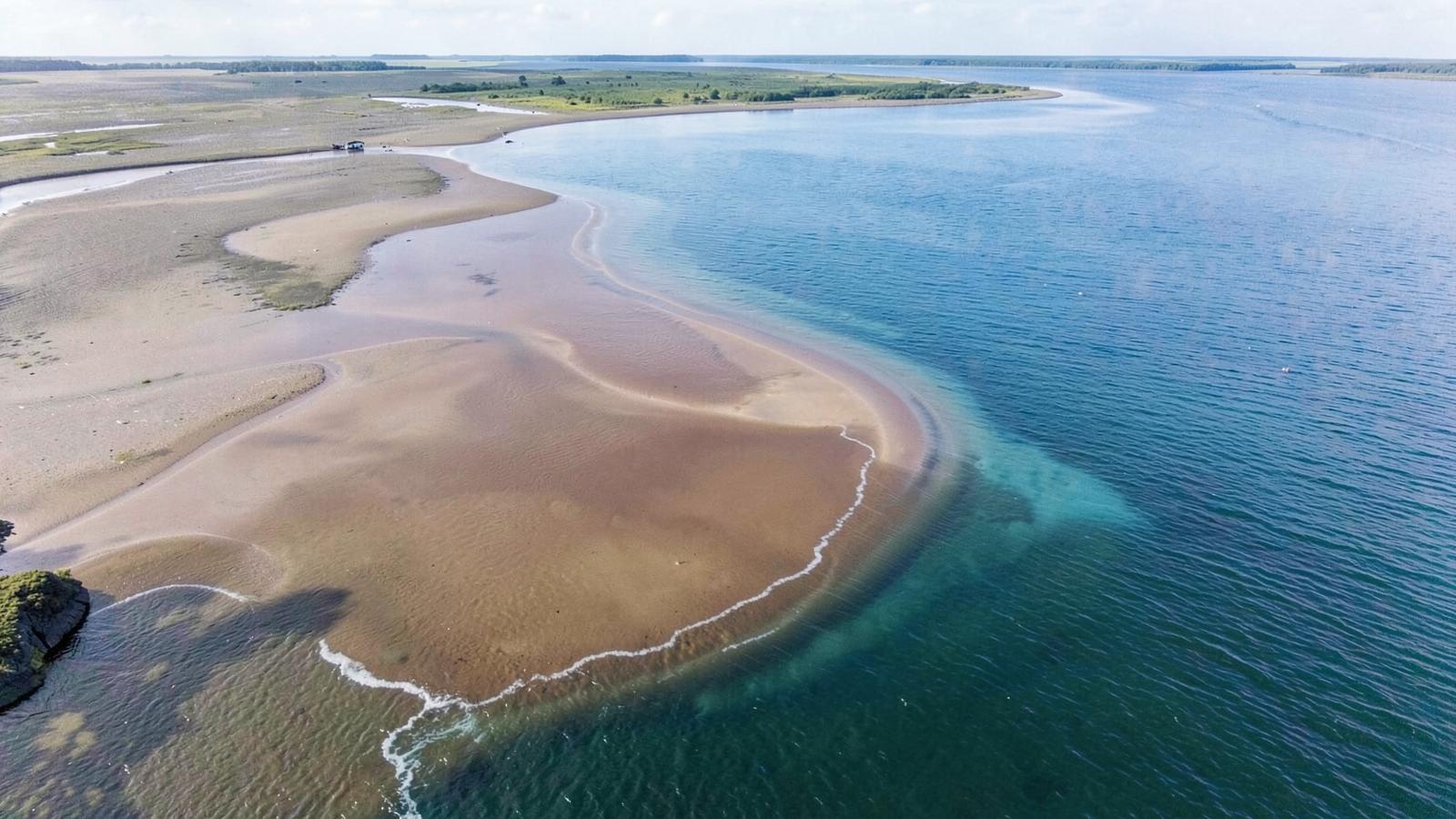
When fresh water and salt water mix, a concentration difference disappears. That difference contains usable free energy. "Blue energy" technologies try to capture part of it before the waters fully mix.
Fresh river water and seawater naturally mix at estuaries. As they mix, ions spread and the concentration difference disappears. Thermodynamically, that mixing releases free energy. Salinity-gradient power — often called blue energy or osmotic power — aims to convert part of that energy into useful electricity.
The idea fits a recurring Ika's Realm pattern: gradients can do work. Batteries use electrical potential differences. Mitochondria use proton gradients. Blue-energy systems use differences in salt concentration.
Reverse electrodialysis: let the ions move
Reverse electrodialysis (RED) uses stacks of ion-exchange membranes arranged so that alternating membranes selectively allow positive or negative ions to pass. Freshwater and seawater flow through alternating channels. The concentration difference drives ions through the membranes in preferred directions, creating an electrical potential across the stack.
Electrodes at the ends of the stack convert the ionic current inside the system into an electronic current that can be used externally. The concept is elegant: controlled mixing becomes electricity.
Pressure-retarded osmosis: use water movement to build pressure
Pressure-retarded osmosis (PRO) uses a semipermeable membrane that allows water to move from a lower-salinity solution toward a higher-salinity solution while restricting salt. The salty side is kept under pressure. Incoming water increases volume and pressure, and that pressurized flow can be used to drive a turbine or other energy-recovery device.
PRO therefore extracts energy through water movement and hydraulic pressure, while RED extracts it more directly through ion transport and electrical potential.
Why estuaries are attractive
Rivers continually deliver fresh water to the sea, replenishing the salinity difference. In principle, this makes estuaries a renewable resource. Unlike solar and wind, salinity gradients are not dependent on daylight or wind speed in the same way, so blue energy is sometimes discussed as a more continuous source.
Global theoretical potential estimates vary widely depending on assumptions, and theoretical energy is not the same as economically recoverable electricity. A 2023 Chemical Reviews article estimated that estuarine salinity-gradient power could represent a meaningful fraction of global electricity demand, but emphasized major practical barriers.
The membrane problem
Membranes are at the centre of both RED and PRO. They must allow selective transport, resist fouling, maintain performance, survive real water chemistry and be affordable at enormous scale. Natural waters contain organic matter, microbes, suspended particles and minerals that can coat or clog surfaces.
Laboratory power density can look impressive, but cleaning, pumping, pretreatment, membrane replacement and pressure losses can erode net energy and economics.
Desalination brine creates a stronger gradient
Desalination plants produce concentrated brine. Pairing very salty brine with a low-salinity stream can create a larger concentration difference than ordinary seawater and river water. Industrial waste streams may therefore become valuable energy resources in some locations.
This does not automatically solve the environmental problem of brine disposal, but integration could potentially recover energy while improving water-system efficiency.
Environmental questions
A blue-energy plant changes how waters are mixed and may require intake structures, pretreatment and discharge. Estuaries are ecologically sensitive zones, so fish, plankton, salinity patterns and local habitats need consideration. A technology can be renewable and still have environmental impacts.
Good design would need site-specific ecological assessment rather than assuming that extracting energy from a natural gradient is impact-free.
Why commercialization has been slow
Blue energy has been studied for decades, but large-scale commercial deployment remains limited. The obstacles are not a lack of physics; they are materials, cost, membrane area, fouling, pumping energy, maintenance and competition with rapidly improving solar and wind power.
Technologies become practical when the whole system works economically, not when a single membrane produces a promising laboratory number.
Where it may make sense first
Blue energy may be most attractive where high- and low-salinity streams already exist close together: desalination facilities, industrial brines, wastewater treatment sites or river mouths with suitable infrastructure. Hybrid systems that combine water treatment and energy recovery may offer better economics than stand-alone power generation.
Research into nanostructured membranes, ion-selective materials and improved stack design continues to push the field forward.
The Ika's Realm takeaway
At the boundary between a river and the sea, nature is continuously erasing a gradient. Blue-energy technology asks whether we can place a controlled pathway in that boundary and collect some of the energy before equilibrium wins.
The concept is simple. The engineering is hard. And that gap between a beautiful physical principle and messy real-world implementation is exactly where future technology becomes interesting.
Key takeaways
- Mixing fresh and salt water releases usable free energy.
- Reverse electrodialysis and pressure-retarded osmosis are the main approaches.
- Membranes, fouling and cost are the practical obstacles.
- Desalination brine offers a stronger gradient and a likely first use case.
Enjoyed this?
Get the next one straight to your inbox.
Keep reading
Related articles
Explore more natural food, fermentation and wellness ideas from Ika’s Realm.
Home Electricity for Beginners — AC, DC, Volts, Amps, Watts and kWh Without the Headache
You do not need to become an electrician to understand your energy bill, a battery or a power station. Five ideas — voltage, current, power, energy and AC/DC — explain most of what beginners need.

Nature Did It First — The Original Engineer
Storage, networks, filters, feedback, insulation, pumps, sensors and self-repair did not begin in factories. Living systems have been solving physical problems for billions of years.

The Leaf Is a Solar Panel — How Living Systems Capture Light
A leaf and a photovoltaic panel both harvest sunlight, but they solve the problem in radically different ways. One makes electrical current; the other builds chemistry, structure and life.